
News & Information
Articles

The What, The Why, and The Way Forward
The What, the Why, and the Way Forward
Building Emotional Intelligence, One Question at a Time
You’re leading an important team meeting. It’s already running over time when a team member asks a question that goes straight to the heart of the discussion. You feel the pressure of the clock. What do you do?

Do you brush the question aside?
Tell the employee they should have listened more closely?
Or pause, thank them for speaking up, and recognize that their question may help everyone leave with a clearer understanding?
If your explanation was unclear, can you acknowledge it?
If your tone was dismissive, can you repair it?
These everyday moments give us opportunities to practice emotional intelligence. How we respond can shape whether people feel comfortable asking questions, sharing concerns, and trusting us to listen.
Understanding emotional intelligence
Emotional intelligence, often called EQ, involves recognizing and understanding emotions in ourselves and others, managing our responses, and using that awareness to navigate relationships. It influences what we say, what we do, and how we respond under pressure.
EQ gained widespread attention in the 1990s. It offers a useful way to think about the skills involved in communicating, handling conflict, and leading people. As I explain during EQ workshops, these skills can be organized into two categories: personal competence and social competence.

Personal competence begins with self-awareness: recognizing what we feel in the moment and understanding our usual responses across situations. Self-management means using that awareness to choose what we say and do.
Social competence includes social awareness: paying attention to other people’s emotions and perspectives while recognizing that our first interpretation may be incomplete. Relationship management brings these skills together to help us handle interactions thoughtfully, especially during stressful situations.
These skills matter at work, at home, and throughout our communities. A difficult conversation with a colleague, a disagreement with a spouse, or an unexpected question from a child can all become opportunities to practice.
We are emotional beings
Think about a conversation that stayed with you long after it ended. Perhaps you replayed a critical comment while driving home or carried frustration from work into an evening with your family. The conversation was over, but your emotional response was still shaping your attention.

Our experiences, expectations, and interpretations influence how we respond. Ten people can witness the same incident and leave with ten different perspectives on what happened. That is a useful reminder to pause before assuming that our interpretation is the whole story.
Under pressure, it can be harder to think carefully and respond as we intended. A pause gives us an opportunity to notice what we are feeling, examine our assumptions, and decide what to say next.
The authors of Crucial Conversations encourage us to examine the story we are telling ourselves. Did a colleague deliberately ignore us, or could they be distracted by something we know nothing about? Before responding, we can separate what we observed from what we assumed.
Ask what to find a way forward
Organizational psychologist and researcher Tasha Eurich explores a related idea in her work on self-awareness: the questions we ask ourselves can affect whether reflection helps us learn or leaves us stuck.
After publishing her book Insight, Eurich read her Amazon reviews and became distressed by the negative comments. She found herself dwelling on why people were being unkind about work she had spent thousands of hours researching to help them. For a couple of weeks, she remained caught in self-criticism.
Then she shifted her attention to what the readers who benefited from her book were saying. That change helped her see more than the criticism. Even someone who studies self-awareness needed to practice a different way of reflecting.
I think of it this way: why questions can keep us looking in the rearview mirror, while what questions can help us see a way forward.

Instead of asking, “Why am I so bad at handling criticism?” we might ask, “What part of this feedback can I use?” Instead of “Why did I lose my temper?” we can ask, “What was I feeling, and what could I do differently next time?”
Why still has a place. Understanding why a process failed can help us prevent another mistake. But when reflection becomes a cycle of blame or self-criticism, asking what can help us identify something useful to do next.
Name what you feel
It is hard to work with an emotion we cannot name. “I feel bad” gives us less information than “I feel disappointed,” “I feel embarrassed,” or “I feel overwhelmed.” Greater precision can help us decide what we need and communicate it more clearly.
The following abbreviated chart from Emotional Intelligence 2.0 offers vocabulary for exploring feelings at different intensities. It is a practical framework for reflection, rather than an exhaustive classification of every human emotion.
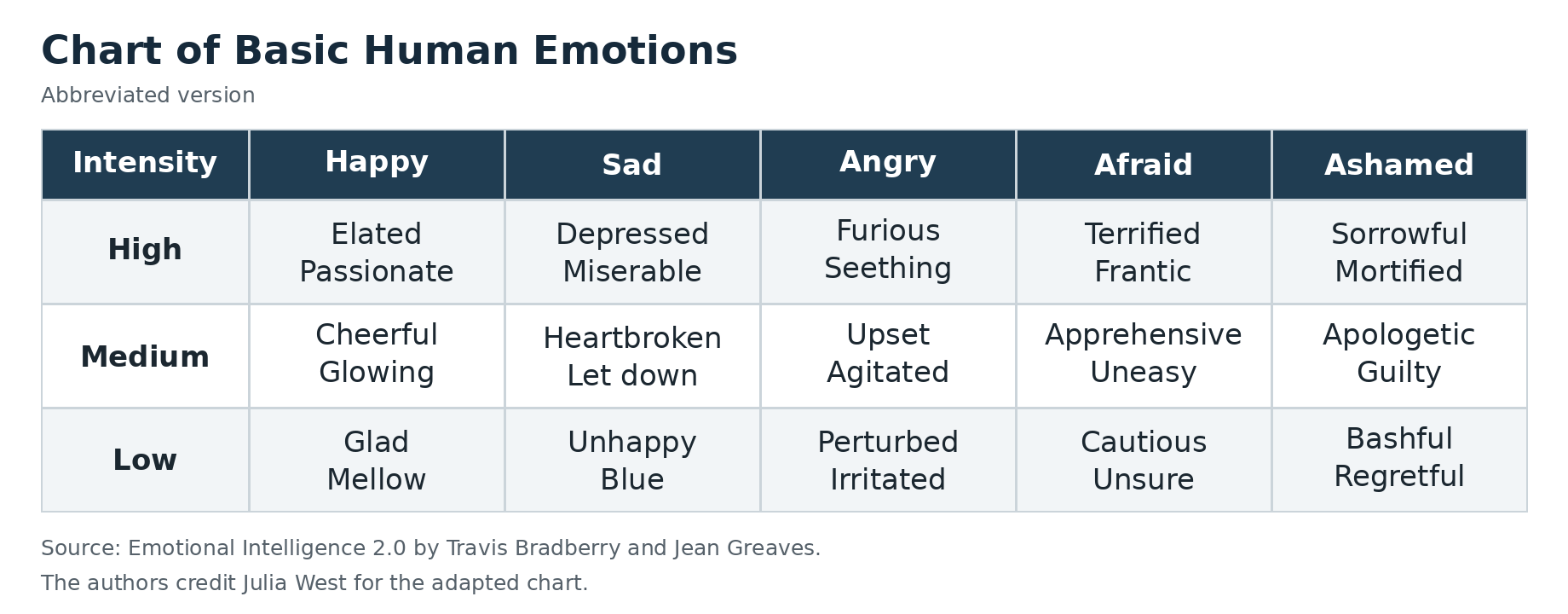
An emotion can be uncomfortable and still provide useful information. We can acknowledge anger without speaking harshly, or recognize fear while deciding how to address the concern behind it.
Practice before the pressure arrives
The good news is that emotional intelligence can be developed through practice and study. One place to begin is a situation in which your emotions took over. What did you notice? What did you assume? What response would you like to practice next time?
~ Find a way to recharge, such as taking a walk or engaging in physical activity.
~ Prepare for important conversations. Gather the information you need and clarify the points you want to discuss.
~ Talk with a trusted mentor or friend who can help you consider another perspective.
~ Think about someone you admire. What might they do in this situation?
~ Make time to think through a difficult issue before responding.
~ When possible, sleep on it before making a decision.

Nine ways to practice EQ every day
1. Practice active listening. “I hear what you’re saying. Could you tell me more about that?” Give the person time to answer before preparing your response.
2. Use empathy and acknowledgement. “I can see this is challenging for you. How can I support you?”
3. Encourage open communication. A new or hesitant team member might benefit from hearing, “If you feel overwhelmed or unsure, please reach out. We can work through it together.”
4. Invite self-awareness. “It’s okay to acknowledge how you feel. Let’s talk about those feelings constructively.”
5. Give constructive feedback with compassion. “You stayed calm during that disagreement. Let’s talk about what could make the next conversation more productive.”
6. Build collaboration and trust. “We’re working through this change together. What support would help you contribute?”
7. Model vulnerability. I appreciate Brené Brown’s work on vulnerability. Sometimes a child or colleague needs to hear, “There are times when I feel unsure, too.”
8. Encourage time to recharge. If a spouse has lost a job, for example, ask how you can support both their job search and their need for rest.
9. Respect differences. I believe each person has a sacred journey. Everyone brings experiences and perspectives we may not share. Listening helps us understand what they can contribute.
Leave room for another story
One of my favorite stories about perspective comes from Stephen R. Covey’s The 7 Habits of Highly Effective People and takes place on a New York subway. A father boards with his young children, who are loud and disruptive. Another passenger grows increasingly irritated as the father does little to intervene.
When the passenger finally speaks to him, he learns that the family has just left the hospital where the children’s mother died. The behavior that seemed so easy to judge suddenly looks very different.
That story reminds me that we do not always know what someone else is living through. Our first interpretation may miss the most important part.

Return to the meeting that opened this article. The clock is still ticking, and the question still needs an answer. You might begin with, “Thank you for asking. I can see that I need to make this clearer.” If there is no time to answer fully, explain how and when you will follow up.
We will not get every response right. But we can notice what we feel, question what we assume, and practice a more thoughtful response. The next time an emotion catches you off guard, try asking: “What am I feeling, what might I be missing, and what can I do next?”

Join Us Every 2nd Friday of the Month
11:30am-1pm